
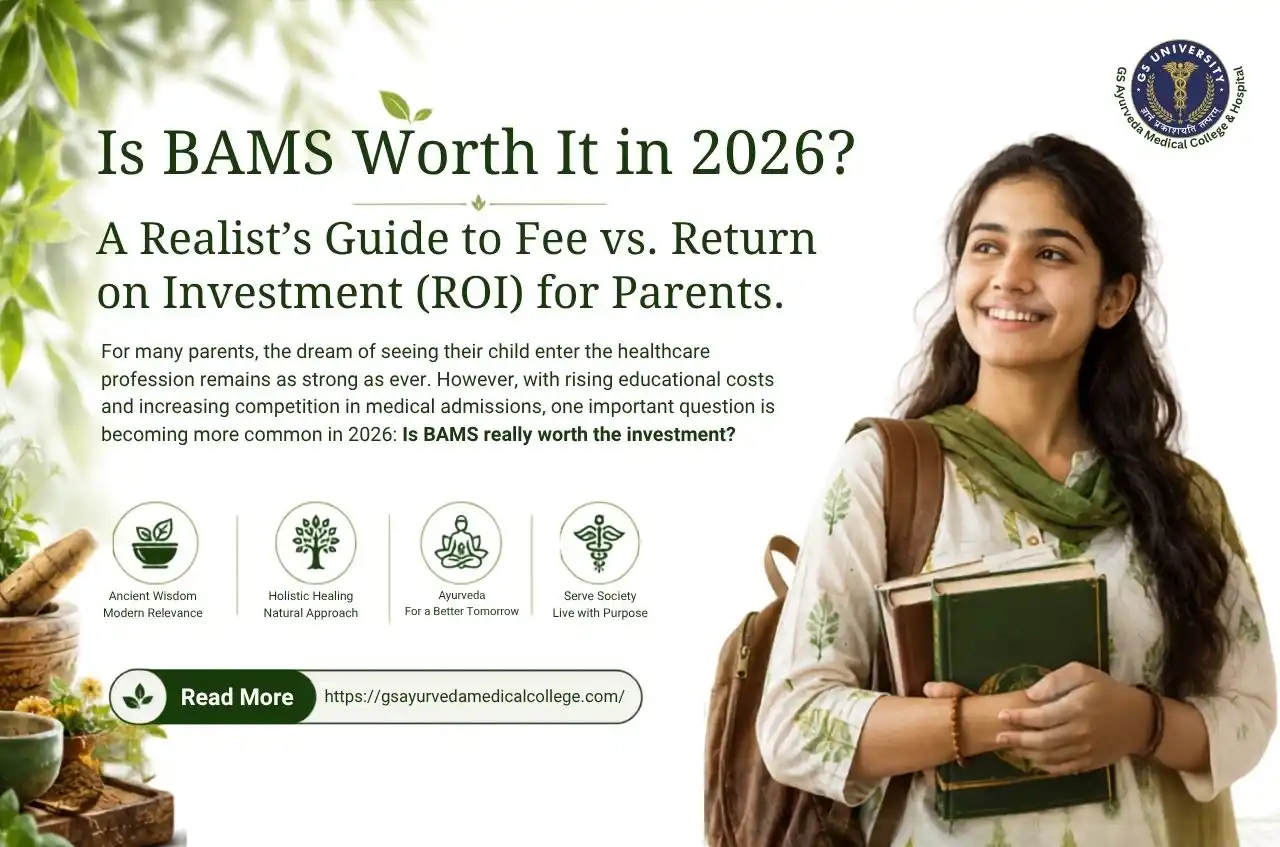
Is BAMS Worth It in 2026? A Realist's Guide to Fee vs. Return on Investment (ROI) for Parents
Introduction
For many parents, the dream of seeing their child enter the healthcare profession remains as strong as ever. However, with rising educational costs and increasing competition in medical admissions, one important question is becoming more common in 2026: Is BAMS really worth the investment?
The Bachelor of Ayurvedic Medicine and Surgery (BAMS) has gained significant popularity over the past decade. Yet parents are no longer looking only at prestige or passion. They are asking practical questions: How much will the course cost? What career opportunities exist after graduation and the duration to recover it?
This guide takes a realistic look at the fees, career prospects, earning potential, and return on investment (ROI) associated with BAMS, helping parents make an informed decision.
Understanding the Growing Interest in BAMS
Ayurveda is no longer considered a traditional healing system. Today, it is part of a rapidly expanding wellness industry that includes preventive healthcare, lifestyle management, nutrition, herbal medicine, and holistic treatment.
The increasing acceptance of integrative medicine, wellness tourism, and natural healthcare solutions has contributed significantly to the demand for qualified Ayurvedic practitioners.
As a result, BAMS has emerged as a viable alternative for students interested in healthcare but unable or unwilling to pursue MBBS.
The Growing Demand for Ayurveda in India and Globally
The future value of any professional degree depends largely on market demand, and Ayurveda is experiencing steady growth across India and international markets. As lifestyle-related illnesses, stress disorders, and chronic health conditions continue to rise, more people are seeking preventive and holistic healthcare solutions. Ayurveda's focus on treating the root cause rather than merely managing symptoms has attracted significant attention from health-conscious individuals.
The global wellness industry is also contributing to this trend. Wellness resorts, Panchakarma centers, herbal product companies, and integrative healthcare facilities increasingly seek trained Ayurvedic professionals. Several countries are exploring traditional medicine systems, creating new opportunities for qualified practitioners.
For parents evaluating ROI, this growing demand is an encouraging sign. Ayurveda nowadays is aligning itself with expanding healthcare trends and is more likely to offer sustainable career scope after BAMS and long-term professional growth.
What Exactly Is BAMS?
BAMS is a professional undergraduate medical degree focused on Ayurvedic medicine and surgery. The course is a good amalgamationof traditional Ayurvedic approachand modern medical sciences.
Course Duration and Structure
The BAMS program generally spans 5.5 years, including:
- 4.5 years of academic study
- 1 year of compulsory internship
Students learn subjects such as:
- Anatomy
- Physiology
- Pathology
- Pharmacology
- Ayurvedic Medicine
- Panchakarma
- Surgery
- Obstetrics and Gynecology
Internship Requirements
Through Internship, students gain practical experience in patient diagnosis, treatment planning, and therapeutic procedures under supervision.
This clinical training plays a crucial role in shaping future career prospects.
Why Parents Are Asking About ROI in 2026
Education is increasingly viewed as an investment nowadays as the cost associated with courses has gone up considerably, and it takes parents a lot of financial planning to keep aside college fees for their children. It is seen just like other investments, such as purchasing property, which are thoroughly evaluated after considering the expected return.
Key questions include:
- What is the total cost of education?
- What salary can graduates expect?
- How quickly can the investment be recovered?
- What are the long-term earning opportunities?
These questions are particularly important because medical education often involves significant financial commitments.
The Cost of Pursuing BAMS
The total investmentto pursue a degree in Ayurveda depends largely on whether the student joins a government or private ayurvedic college.
Private Vs Government BAMS College Fees
Government College Fees
Government BAMS colleges remain the most affordable option.
Approximate annual tuition:
- ₹20,000 to ₹1 lakh per year
Total educational cost over the course may range between:
- ₹1.5 lakh to ₹6 lakh
For students securing government seats by getting good score in NEET-UG, ROI can be considerably reduced due to the relatively low investment.
Private College Fees
Private institutions charge considerably higher fees.
Typical tuition fees:
- ₹2 lakh to ₹5 lakh annually
- Premium institutions may charge even higher amounts
Total tuition expenditure may range from:
- ₹12 lakh to ₹30 lakh or more
Parents should carefully evaluate the reputation and placement support of private colleges before making a financial commitment.
Hostel, Books, and Living Expenses
Additional expenses include:
- Hostel accommodation
- Food
- Books
- Clinical instruments
- Transportation
- Examination fees
These costs can add another ₹3 lakh to ₹8 lakh during the entire course duration.
Comparing BAMS Costs with Other Medical Courses
When compared with MBBS, BAMS is often significantly more affordable.
Private MBBS programs may cost anywhere from ₹50 lakh to over ₹1 crore in many institutions.
By contrast, BAMS often requires a fraction of that investment while still providing access to healthcare careers.
For many middle-class families, this affordability becomes a major advantage.
Career Opportunities After BAMS
One of the biggest misconceptions is that BAMS graduates have limited career options.
In reality, opportunities have expanded considerably.
Clinical Practice
Private practice offers:
- Professional independence
- Flexible working hours
- Long-term income growth
- Community recognition
A successful clinic can eventually become a highly profitable venture.
Hospital Employment
BAMS doctors are employed in:
- Ayurvedic hospitals
- Multi-speciality hospitals
- Wellness centers
- Rehabilitation facilities
Hospital employment offers stable income and valuable clinical exposure.
Wellness and Integrative Healthcare
The wellness sector is experiencing remarkable growth.
Opportunities exist in:
- Panchakarma centers
- Wellness resorts
- Lifestyle clinics
- Corporate wellness programs
- Holistic healthcare organizations
This sector particularly rewards professionals who combine medical expertise with communication and management skills.
Government Sector Opportunities
Government positions may be available through:
- State health departments
- AYUSH departments
- Public health programs
- Teaching institutions
Government jobs often provide stability, benefits, and long-term career security.
Expected Salary After BAMS
BAMS Doctor Salary in India largely depends on skills, experience, and career path.
Fresh Graduate Earnings
New graduates generally earn between:
- ₹20,000 and ₹50,000 per month
Mid-Career Income Potential
After 5 to 10 years of experience, earnings commonly increase to:
- ₹6 lakh to ₹15 lakh annually
Professionals who develop specialization and patient trust often experience stronger financial growth.
Private Practice Growth Potential
Private practice creates the highest earning ceiling.
Some experienced BAMS practitioners earn ₹15 lakh to ₹50 lakh per annum or even more.
However, such outcomes require years of dedication, reputation building, and patient acquisition.
Long-Term Career Stability and Professional Respect
One of the most overlooked aspects of ROI is career stability. People will always require treatment, preventive care, and wellness support, creating consistent demand for qualified healthcare professionals.
A career in Ayurveda can offer not only financial returns but also long-term professional security, and also it can be deeply satisfying at a personal level when you become the reason of someone’s happiness.
For parents, these intangible benefits matter too. A profession that combines financial sustainability with societal respect can deliver value that extends far beyond salary figures.
Factors That Influence ROI in BAMS
Not all BAMS graduates experience identical outcomes.
Several variables influence long-term returns.
College Reputation
Graduates from well-established institutions often benefit from:
- Better clinical exposure
- Stronger professional networks
- Enhanced credibility
The quality of education directly impacts career readiness.
Clinical Exposure
Medicine is ultimately a practical profession.
Students receiving extensive patient exposure during training typically develop stronger diagnostic and treatment skills.
These competencies often translate into higher earnings later.
Location of Practice
Location significantly affects income.
Doctors practicing in metropolitan areas may access larger patient populations, while those in smaller towns may face less competition.
The ideal location balances demand and competition.
Entrepreneurial Skills
Many high-earning BAMS professionals are excellent entrepreneurs.
Success increasingly depends on:
- Patient communication
- Digital marketing
- Clinic management
- Personal branding
Medical knowledge alone is no longer enough.
The Importance of Skill Development Alongside a BAMS Degree
A BAMS degree provides a strong foundation in Ayurvedic medicine, but long-term success often depends on the additional skills students develop along the way. Today's healthcare environment rewards professionals who can effectively communicate, build patient trust, and adapt to changing technologies.
So along with the regular degree of BAMS, students should focus on developing skills related to counseling, healthcare management, digital marketing skills, and basic business management skillswhich can significantly enhance career prospects. Doctors who understand how to manage a clinic, engage with patients online, and build a professional reputation often grow faster than those relying solely on academic qualifications.Continuous learning not only improves employability but also strengthens the overall return on investment from a BAMS education.
Challenges Parents Should Know Before Investing
Every educational path has risks.
Common challenges include:
- Competitive healthcare market
- Time required to build patient trust
- Variations in state regulations
- Need for continuous professional development
Parents should enter the decision with realistic expectations rather than assuming immediate financial success.
Is BAMS Better Than MBBS for Some Students?
This may sound surprising, but for certain students, the answer can be yes.BAMS can be good alternative to MBBS after NEET considering the fees and interest of the student in ayurveda.
If a student:
- Has genuine interest in Ayurveda
- Values holistic healthcare
- Prefers wellness-focused medicine
- Cannot justify extremely high MBBS fees
then BAMS may provide a better financial and personal fit.
The best career choice is not always the most prestigious one—it is the one that aligns with a student's interests and strengths.
Higher Education Options After BAMS
Career growth often accelerates with postgraduate education.
MD/MS in Ayurveda
Specialization can improve:
- Clinical expertise
- Employability
- Academic opportunities
- Income potential
Postgraduate qualifications often increase credibility among patients and employers.
Research and Academics
Graduates can pursue careers in:
- Medical education
- Research institutions
- Clinical trials
- Healthcare policy
These paths are particularly attractive for students interested in scientific exploration and teaching.
Realistic ROI Scenarios for Different Students
Consider three hypothetical situations.
A student graduating from a government college with total expenses of ₹5 lakh may recover the investment within a few years of employment.
A private college student spending ₹20 lakh may require a longer recovery period but can still achieve attractive long-term returns through specialization or private practice.
A highly entrepreneurial graduate who builds a successful wellness center could potentially achieve returns far exceeding the original educational investment.
The difference often lies not in the degree itself but in how it is utilized.
Who Should Choose BAMS in 2026?
BAMS may be an excellent choice for students who:
- Enjoy biology and healthcare
- Believe in holistic medicine
- Have patience for long-term career growth
- Are willing to continuously learn
- Possess strong interpersonal skills
Such students are often well-positioned to thrive in the profession.
Who Should Avoid BAMS?
BAMS may not be ideal for students who:
- Have no interest in Ayurveda
- Expect instant high salaries
- Prefer non-clinical careers
- Dislike interacting with patients
- Choose the course only as a backup option
Medicine requires commitment, regardless of the specialization.
Final Verdict on BAMS ROI
If you evaluate the investments and subsequently return, BAMS ROI for parents is fairly good.
The degree does not promise overnight wealth, but provides stable career opportunities, professional respect, and good long-term earning potential.
For students entering reputable institutions and actively building their skills, the financial returns can be highly satisfactory over time.
Conclusion
So, is BAMS worth it in 2026? The answer depends on the student, the college, and the family's expectations. If parents view BAMS as a long-term professional investment rather than a shortcut to immediate financial success, it can be a rewarding choice. With growing interest in preventive healthcare, wellness services, and integrative medicine, qualified Ayurvedic professionals are likely to remain relevant in the evolving healthcare landscape. The smartest approach is to evaluate both passion and practicality—because the best ROI comes when career satisfaction and financial success grow together.
FAQs
1. What is the average BAMS course feestructure in a private college in 2026?
Private BAMS colleges typically charge between ₹12 lakh and ₹30 lakh for the complete course, excluding living expenses.
2. Can a BAMS doctor earn as much as an MBBS doctor?
While income varies greatly, experienced BAMS practitioners with successful clinics or wellness businesses can achieve earnings comparable to many healthcare professionals.
3. How long does it take to recover the cost of a BAMS degree?
Depending on total educational expenses and career progression, investment recovery may take anywhere from 3 to 10 years.
4. Is postgraduate education necessary after BAMS?
It is not mandatory, but pursuing MD/MS in Ayurveda can significantly improve specialization, career opportunities, and earning potential.
5. Is BAMS a good option for budding ayurvedic entrepreneurs?
Yes. Many BAMS graduates successfully establish clinics, wellness centers, Panchakarma facilities, and healthcare businesses, creating strong long-term ROI.